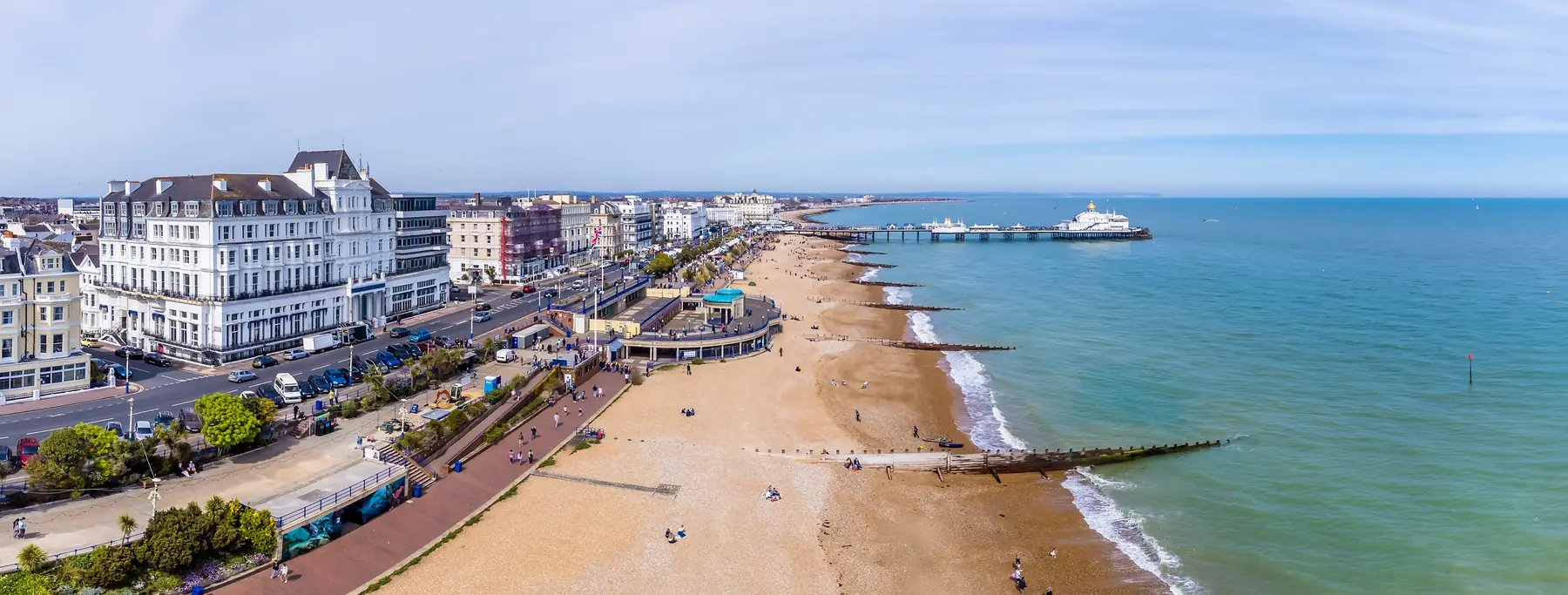
Eastbourne claims to be the sunniest place in the United Kingdom, and the figures broadly support it — the town sits in a corner of the coast sheltered by the Downs behind it and records some of the highest annual sunshine totals in the country. That is a genuine reason to come here, and it is also no help at all on the day the rain arrives.
Fortunately Eastbourne is a substantial town of over a hundred thousand people with a serious art gallery, three theatres, a science centre in a former Royal Observatory and a scatter of castles within half an hour. A wet day here is not a wasted one.
Free to enter, and much better than a seaside town has any right to expect. The Towner holds one of the most significant public art collections in the south-east — a very large body of work by Eric Ravilious in particular, whose Sussex downland paintings are the best possible preparation for walking the same ground — alongside a serious programme of contemporary exhibitions. The building itself, wrapped in a coloured mural, is a landmark, and there is a café. Two hours, and it costs nothing. See our Towner page.
Eastbourne has three: the Congress Theatre, the Devonshire Park Theatre and the Winter Garden, all in the Devonshire Park quarter and all recently restored. Between them they carry touring drama, musicals, comedy, concerts and pantomime through the year. A matinee is the most comfortable possible response to a wet Eastbourne afternoon, and the Devonshire Park Theatre in particular is a lovely Victorian house.
A proper Victorian pleasure pier with an arcade, shops, food and a camera obscura, much of it under cover. It is not a full afternoon, but it is a very good hour, and being on a pier while it rains on the sea is a specific pleasure.
The circular Napoleonic fortress on the eastern seafront, built to resist an invasion that never came. Opening varies, so check before setting out.
The Beacon shopping centre and the covered streets around Terminus Road cover the practical needs, and the town has an unusually good independent restaurant scene for a wet lunchtime — see our eating guide.
Twelve kilometres north at Herstmonceux, in the green copper domes of the former Royal Greenwich Observatory. It is a hands-on science centre with a very large number of exhibits that children and adults can operate, explaining engines, optics, pumps and electronics, plus the historic telescopes themselves. Most of it is indoors and it is the single best wet-weather destination in the area.
Next door. A fifteenth-century moated brick castle, one of the oldest significant brick buildings in England, with guided tours of the interior and extensive gardens. The tour is thorough and adult-paced; the gardens are the outdoor part, so a wet day tilts the visit indoors.
Twenty-two kilometres north-east. The abbey was founded on the site of the Battle of Hastings and is now an English Heritage property with a visitor centre, an exhibition and the battlefield itself. The buildings and the exhibition give you a couple of hours under cover, and the battlefield walk is worth doing in any weather — standing on the actual ground is the point.
Seven kilometres east. A Roman Saxon Shore fort with a Norman castle inside it. It is largely open-air and a ruin, which makes it a poor wet-weather choice; go on a clear day instead.
Brighton is thirty-one kilometres west and under forty minutes by direct train — the Royal Pavilion, the museums, the Lanes and a great deal of covered shopping. It is the obvious full wet-day escape.
Lewes, twenty-five kilometres north-west, has a castle, the Anne of Cleves House and a very good bookshop-and-pub culture.
Bexhill, fifteen kilometres east, has the De La Warr Pavilion — a 1935 modernist building on the seafront that is now an arts centre with free galleries, a café and a terrace. It is a fine thing to look at from inside while the weather does its worst.
Hastings, twenty-eight kilometres east on the Marshlink line, has the caves, the fishing quarter museums and the funicular railways.
Two options. The promenade is six kilometres of level surfaced path with shelters along it, and walking a stretch of it in a squall is bracing rather than miserable. And the Pevensey Levels to the east are flat, quiet and about big skies — which are at their most dramatic under weather.
Avoid the cliffs. Beachy Head and the Seven Sisters in rain and low cloud are exposed, slippery on the chalk, and genuinely hazardous near the edge. Save them for a clear day; our cliffs guide explains why.
Trains make Eastbourne unusually good at wet-day escapes: Brighton in under forty minutes, Lewes in twenty, Hastings in around half an hour, Gatwick in an hour and London Victoria in about an hour and a half, all direct from a station in the middle of town.
Parking in the town includes free options at the Enterprise Shopping Centre, Trinity Place and the eastern seafront, which fill faster in bad weather.
Opening. The Redoubt, Herstmonceux and several of the smaller attractions have seasonal hours and close over the winter. Check before you drive.
The shape that works: the Towner first thing, which is free, indoors and takes a comfortable two hours. Lunch in the Cornfield quarter behind the station, five minutes’ walk. Then either a matinee at one of the three Devonshire Park theatres, or the drive north to the Observatory Science Centre at Herstmonceux for the afternoon. Finish with a walk along the promenade in whatever the weather is doing, because a Victorian seafront in a squall is a genuinely good sight, and there are shelters every few hundred metres for exactly this.
If the rain has set in for days rather than hours, the train is the answer: Brighton, Lewes and Hastings are all under forty minutes and all have more indoor options than a town of this size can manage.
Eastbourne’s claim to be the sunniest place in the UK is not marketing invention — the town regularly appears at or near the top of the annual sunshine tables, helped by its position on a south-facing coast with the Downs sheltering it from the north and west.
The practical consequence for a visitor is that weather here often clears faster than the forecast suggests, and that the cliffs to the west can be in cloud while the town is in sun, or the reverse. It is worth looking out of the window before you commit to an indoor day.
The seafront shelters are a real amenity rather than a curiosity — the Victorian promenade was built with covered seating every few hundred metres, and sitting in one watching a squall come across the Channel is a legitimate way to spend twenty minutes. The pier’s covered sections do the same job with an arcade attached.
Indoors, the Towner’s café is free to sit in, the Beacon centre covers the practical shopping, and the Cornfield quarter behind the station has enough small restaurants and coffee shops that you can move between them without a coat.
The Towner gallery for free, a matinee at one of the three theatres, the pier, and the Observatory Science Centre twelve kilometres north.
Yes, entry to the gallery is free, with charges only for some special events.
The Observatory Science Centre at Herstmonceux — hands-on, indoors and good for a wide age range.
It records among the highest annual sunshine totals in the country and makes the claim on that basis. It still rains.
You can, but you should not go near the edge, and the chalk is treacherous when wet. The promenade is the better wet-weather walk.