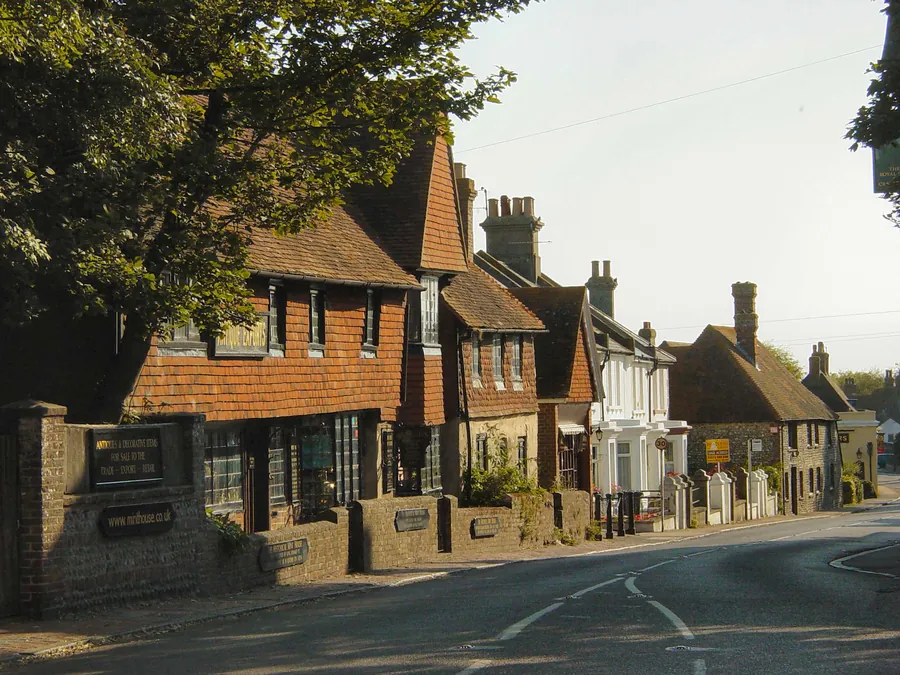
Pevensey is a village and civil parish in the Wealden district of East Sussex, built on a spur of sand and clay about 33 feet (10 m) above sea level. In Roman times that spur was a peninsula pushing out into a tidal lagoon, and the fort the Romans put on the end of it is still standing. William the Conqueror landed here in September 1066 and found nobody defending it.
That single walled enclosure is the reason to come out from Eastbourne. It was built as a Roman coastal fort between AD 300 and 340, besieged and burned by the Saxons, refortified by Harold Godwinson in 1042, granted to William’s half-brother after the Conquest, ordered demolished by Elizabeth I and not demolished, and then adapted in 1942 to spot German aircraft. The same walls were still doing the same job in the Second World War.
Wikipedia puts the main village five miles (8 km) north-east of Eastbourne and one mile (1.6 km) inland from Pevensey Bay; the straight-line distance from Eastbourne is 6.7 km. The A259 passes through, and two railway stations serve the parish.
Pevensey Castle is two castles sharing one outline. The outer bailey wall is Roman: the fort was called Anderitum, one of eleven built between Essex and the Isle of Wight against Jutish and Saxon raiding, with the sea washing round it on three sides. After the Conquest, Robert, Count of Mortain, made only minor repairs to that wall and built a new inner bailey at the eastern end. At the Domesday survey of 1086 the settlement had 110 households and a mill. The castle is now in the upkeep of English Heritage.
It carries 4.5 from 2,701 Google reviews, and those reviews divide over whether the ruin repays a visit. A visitor in June 2026 found it “Very spacious and great information”. A visitor in August 2026 gave two stars — “not much to see I wouldn’t even say it was worth that much either” — and reported that a friend’s unused family ticket proved non-transferable. A five-star review that month is better on logistics: “Plenty of parking with a pub on the corner. Don’t forget the ghost tours and visit the mini jail.”
Pevensey has 23 buildings of historic significance listed by English Heritage, among them the Grade I St Nicolas parish church and the Grade II* Old Mint House. The Mint House carries 4.9 from 14 Google reviews, too few to weigh, and its condition is the more telling fact: in 2022 English Heritage added it to its list of buildings at risk of disrepair.
The other stop is Pevensey Court House Museum and Gaol, 4.6 from 39 Google reviews — a small sample for a small building. It is what survives of the town’s own government: King John granted a royal charter in 1207, Pevensey Corporation ran the place until it was dissolved in 1886 and borough status went with it, and the Pevensey Town Trust now manages what the Corporation owned, this building above all.
Pevensey Bay is a separate settlement in the same parish, sitting behind and on the shingle. Wikipedia describes it as small but a seaside resort in miniature, with many of the facilities of bigger ones. Before development it was called Wallsend, and the 16th-century Castle Hotel stood alone on the beach. Two Martello towers built in 1806 against Napoleonic attack remain, from the more than 100 raised along this coast.
The beach is stones rather than sand, and reviewers say so plainly. It carries 4.5 from 311 Google reviews. A visitor in May 2026 called it “Beautiful but stoney”, suggested jelly shoes, noted “Lots of people paddleboarding”, and gave the clearest warning here: “Easy access to carpark but steep sloping stoney beach so difficult for people with mobility issues”. A visitor in July 2026 wrote, “Lovely quiet beach loved it”.
The shingle is also the flood and storm defence for a large area of low-lying land behind it, on a clay bay that erodes over time.
The lagoon that once surrounded the fort ran inland as far north as Hailsham and eastwards to Hooe. Longshore drift sealed it off with shingle, and what remains behind the beach is the Pevensey Levels: roughly 47 square miles (120 km2) of marsh, plus Pevensey Haven, the small river along the north side of the old peninsula, now largely silted up. The village takes its name from that river — Pevensey means “River of [a man named] Pefen”.
The Levels are a Site of Special Scientific Interest and a large nature reserve jointly owned by Natural England and the Sussex Wildlife Trust, holding nationally rare plants and invertebrates including the fen raft spider. The site is fragile and general access is not permitted, so this is a landscape to look across rather than walk into. The 1066 Country Walk, a long-distance footpath through the historical sites of the area, starts at Pevensey.
Losing the water cost the town its trade. In the 16th century Pevensey was a “non-corporate limb” of Hastings within the Confederation of the Cinque Ports, and its importance dwindled as the ports became disconnected from the sea; by then it stood two miles (3.2 km) distant. What the coast kept was smuggling: through the 18th and 19th centuries Pevensey Bay was one of the easier places to land contraband, and in 1833 there was a violent clash there between smugglers and customs men.
Two stations serve the parish, both with pages on the Southern site: Pevensey and Westham, 6.0 km from the centre of Eastbourne and rated 4.3 from 21 Google reviews, and Pevensey Bay, 6.9 km out and 3.4 from 8. Trainmap.co.uk counts 83 direct trains a day between Eastbourne and Pevensey and Westham on weekdays. Pick the right one: the castle and the old village sit by Pevensey and Westham, the beach by Pevensey Bay. By road, the A259 runs through.
On buses, nothing here establishes a timetable. The only account available is a visitor’s, writing in July 2026 from a holiday park at Pevensey Bay: the “Bus ( 99 ) short walk to road, takes you into Eastbourne or the other way Hastings”. Treat that as one person’s report rather than a published service.
The village and what is around it, at walking scale.
Open any of them in Google Maps for directions and current opening.
Attractions, prices and availability in Eastbourne
These come from GetYourGuide's booking widget, which sets their cookies in your browser. Consent to load it and see the attractions and prices.
Background on Pevensey draws on its Wikipedia article, text there being available under CC BY-SA 4.0.