Eastbourne is at the eastern end of the South Downs, and that single fact shapes all the walking here. The chalk that runs across southern England for a hundred and fifty kilometres reaches the sea at Beachy Head, immediately west of the town, and falls into it as the highest chalk sea cliff in Britain. The South Downs Way, the national trail that runs the length of the range, starts — or finishes — in Eastbourne itself.
East of the town the landscape does the opposite: the Pevensey Levels, a flat expanse of drained marsh with dykes, grazing and enormous skies, running out to the shingle at Pevensey Bay.
So a walking week here divides between the cliffs, the open downland behind them, and the levels. Distances are from the town centre.
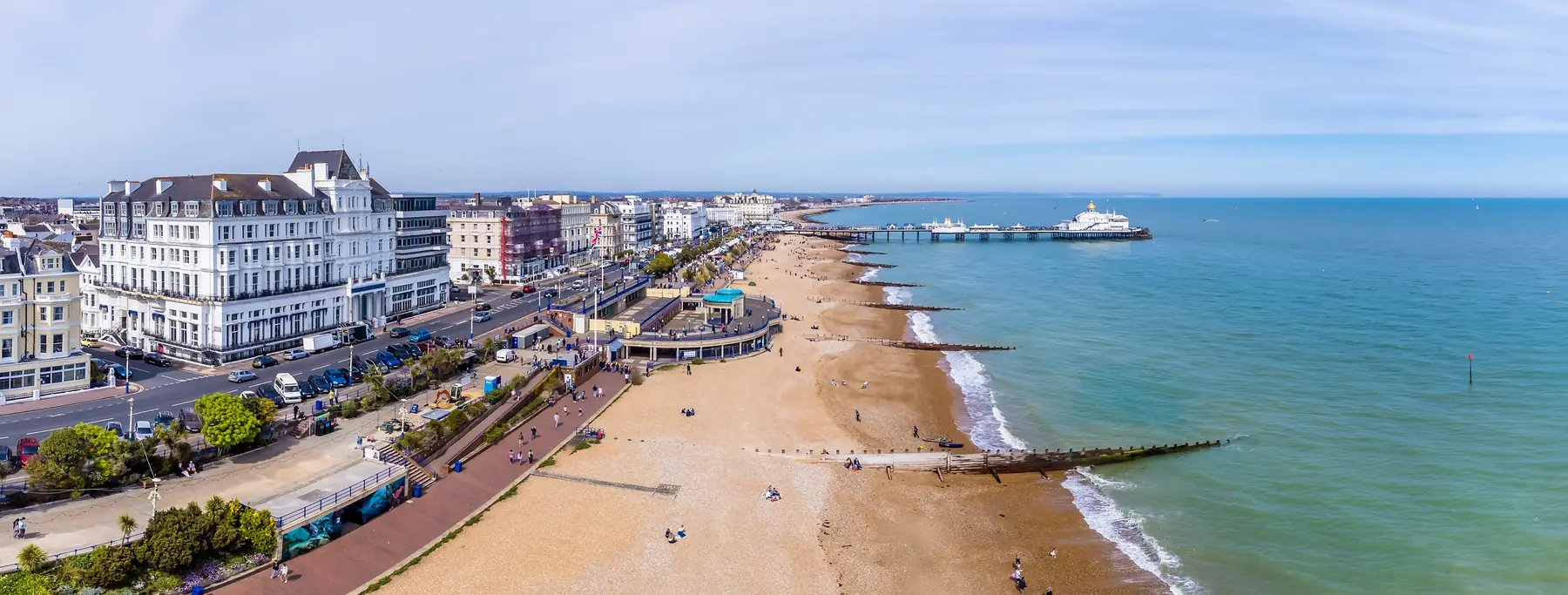
Eastbourne’s seafront is unlike any other on this coast because the Duke of Devonshire’s estate has controlled the frontage for well over a century and would not allow it to be turned into arcades and shops. What you walk along is a Victorian promenade of hotels, gardens and the 1935 bandstand, with almost nothing commercial between the pier and Holywell.
The walk from Sovereign Harbour in the east to Holywell in the west is about six kilometres of level, surfaced promenade with the sea on one side the whole way. It is the town’s default walk and it is genuinely good.
Two kilometres east of the centre, Princes Park is thirty-three acres of boating lake, putting green and lawns behind the beach. It links to the Redoubt and the eastern promenade and makes an easy circuit from the town.
The walk west from the seafront climbs past Holywell to the Downland and out onto Beachy Head — a steady, exposed ascent with the town falling away behind you and the lighthouse appearing below at the foot of the cliff. It is about five kilometres from the pier and takes an hour and a half at a fair pace.
The cliff top is open access grassland and you can walk for miles along it. There is a car park at Beachy Head, and buses run along the clifftop road in season. Our Beachy Head and Seven Sisters guide covers it in full, including the safety points, which matter here more than almost anywhere else on the English coast.
Continue west and the cliff drops to Birling Gap, where there is a National Trust visitor centre, a café, and steps down to the beach — one of the very few places on this stretch where you can get to sea level. Beyond it the Seven Sisters begin: seven chalk headlands with six dips between them, and a walk that goes relentlessly up and down for six kilometres to Cuckmere Haven.
It is harder than it looks. The Sisters are not high individually, but doing all of them in one go is a genuine day’s walking, and there is no shelter, no water and no way off the route in the middle.
A practical note that regular visitors make: the Birling Gap visitor centre and car park get completely overwhelmed on hot summer weekends. Go early, go midweek, or arrive by bus.
The Cuckmere meanders through water meadows to a shingle beach with no development on it at all — the view from Seaford Head back across the river mouth to the Seven Sisters is one of the most photographed in England. The Seven Sisters Country Park visitor centre at Exceat, eight kilometres from Eastbourne, is the usual starting point, and the flat walk down the valley to the sea and back is around six kilometres with almost no climbing. It is the easiest way to see this landscape.
Thirteen kilometres west, on the far side of the Cuckmere. The nature reserve on the headland gives the classic view of the Sisters and the coastguard cottages, and the walk from Seaford is short and steep.
The national trail begins at Eastbourne and runs 160 kilometres west to Winchester. The first section, out of the town and over the Downs to Alfriston, is one of the best days on the whole route — there is a choice of an inland route over the tops and a coastal route over the Seven Sisters, and they rejoin at Alfriston.
Walking out to Alfriston and getting the bus back is a superb full day of around eighteen kilometres.
Ten kilometres north-west, cut into the chalk of Windover Hill above the village of Wilmington: a seventy-metre human figure holding two staves, of thoroughly disputed date. The walk up to it from the village car park is short and steep, and the ridge above gives a view over the Weald.
Ten kilometres north-west, a village of flint and timber on the Cuckmere with a market cross, a large church known as the Cathedral of the Downs, and the Clergy House — the first building the National Trust ever bought, in 1896, for ten pounds. It is a natural walking base and the paths along the river north and south of it are gentle.
Seven kilometres east, Pevensey Castle is a medieval castle inside the walls of a Roman Saxon Shore fort, and the place where William landed in 1066. It is English Heritage and open to visitors; some find it a slight visit for the price, so set expectations for a substantial ruin rather than a furnished castle.
Behind it, the Pevensey Levels are a national nature reserve of drained marsh, dykes and grazing — flat, quiet, big-skied, and one of the most important wetland invertebrate sites in Britain. It is walking of a completely different character from the Downs, and much less visited.
The shingle coast between Pevensey Bay and Eastbourne’s marina is a level six-kilometre walk with the Martello towers of the Napoleonic coastal defences along it.
Buses run along the seafront, out to Beachy Head and Birling Gap in season, and to Alfriston, Seaford and Pevensey, which makes linear walks straightforward. The open-top service along the cliffs in summer is worth taking for its own sake.
Trains put Seaford, Lewes, Bexhill and Hastings within reach for one-way walks.
Parking at the trailheads: Beachy Head, Birling Gap, Exceat and Alfriston all have car parks that fill by mid-morning at weekends. In the town, the free options include Fishermen’s Green and the Redoubt on the eastern seafront, and Heathy Brow and Warren Hill up on the Downland.
Weather. Eastbourne claims the highest sunshine figures in Britain, which makes the cliffs hot and shadeless in summer. Carry water; there is none between Birling Gap and Cuckmere.
Underfoot. Chalk grassland drains fast but is extremely slippery when wet, particularly on the steep descents into the dips between the Sisters.
Flat and surfaced: the promenade from Sovereign Harbour to Holywell, six kilometres with benches and shelters the whole way. Suitable for wheelchairs and pushchairs.
Flat but unsurfaced: the Cuckmere valley from Exceat down to the sea, about three kilometres each way; and the Pevensey Levels, which are dead level but can be wet underfoot.
One climb, then easy: Eastbourne to Beachy Head. The ascent is out of the way in the first half hour and the clifftop beyond it is gentle.
Sustained effort: the Seven Sisters from Birling Gap to Cuckmere Haven — six kilometres of continuous up and down with no escape route.
A full day: the South Downs Way from Eastbourne to Alfriston, eighteen kilometres, with a bus back.
Spring is the best time for the downland flowers and the skylarks, and the paths are quiet before the summer crowds.
Summer brings the crowds to Birling Gap and Beachy Head and turns the clifftop hot and shadeless. It also brings the long evenings, and a walk out to Beachy Head at seven in the evening is the best two hours of the Eastbourne day.
Autumn is the bird migration season, and Beachy Head is a well-known watch point for birds moving along the coast.
Winter is dramatic and empty. The chalk is slippery, the wind on the edge is serious and the light is extraordinary.
About five kilometres from the pier on foot, an hour and a half’s walk uphill, or a short bus ride along the clifftop road.
Yes. Birling Gap to Cuckmere Haven is around six kilometres of continuous ascent and descent, and most people allow three hours for it plus the walk in and out.
In Eastbourne, running 160 kilometres west to Winchester, with a choice of inland and coastal routes for the first section.
Several: the seafront promenade, the Cuckmere valley from Exceat to the sea, and the Pevensey Levels.
The paths are, if you stay on them. The cliff edge is not — the chalk is unstable and falls without warning. Keep well back.