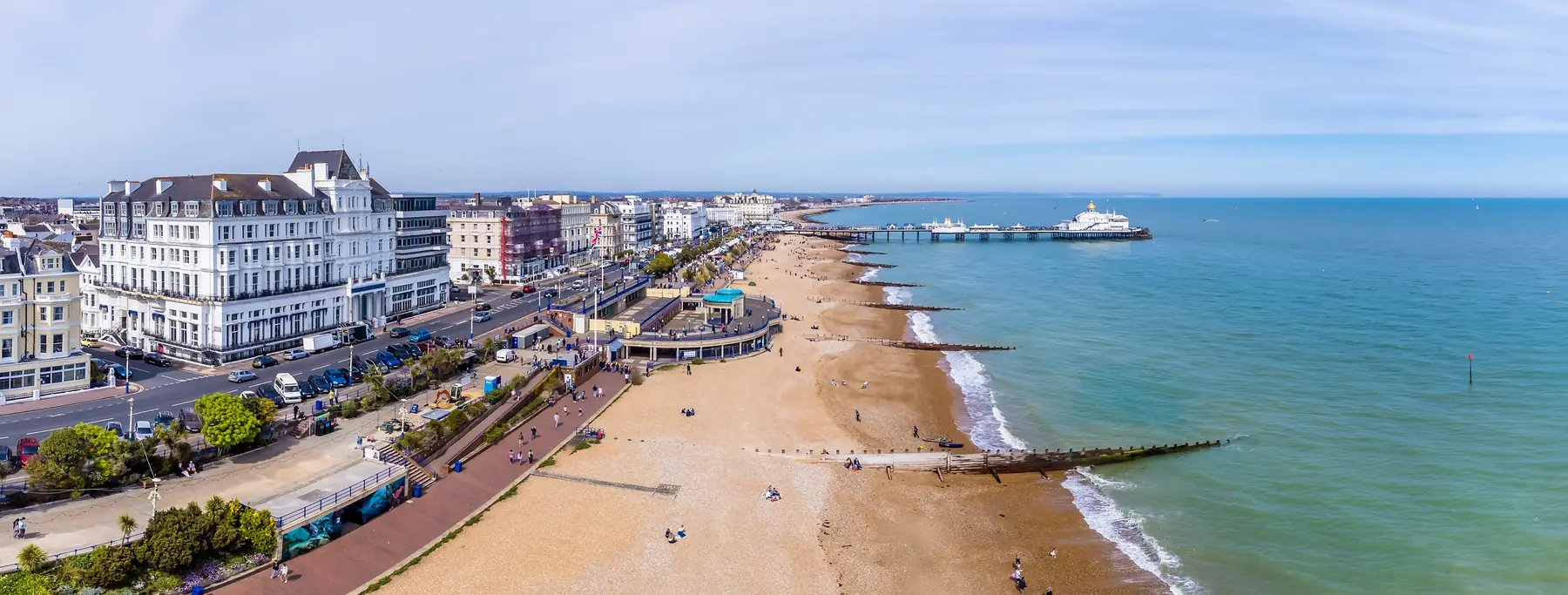
Eastbourne is an old-fashioned family resort in the best sense. The seafront is Victorian and largely free of arcades, the beach runs the length of the town, and within fifteen kilometres there is a zoo, an adventure park, a hands-on science centre in a former Royal Observatory, a miniature steam railway and a moated brick castle. Almost all of it is cheaper than the equivalent in Brighton and considerably less frantic.
The other advantage is the geography: the town is flat, the promenade is six kilometres of level surfaced path, and the train station is a ten-minute walk from the pier.
Ten kilometres west near Alfriston, Drusillas is a small zoo — about ten acres — that attracts well over a third of a million visitors a year, which tells you how well it is pitched. It is built for young children specifically rather than for a general audience: the animal enclosures are at child height, the play areas are extensive, and the whole site can be done in a day without anyone being carried. See the Drusillas page.
Eleven kilometres north at Hailsham. A large outdoor activity park with rides, animals, play areas, water activities and enough range that a family with children of different ages can all find something. Families routinely report spending the whole day and not covering it.
Two kilometres from the centre, and the local secret. A ride-on miniature railway, several model railways, a large playground and grounds to explore — cheap, well kept and exactly right for younger children. It is the sort of place that gets consistently affectionate reviews from people who did not expect much.
Twelve kilometres north at Herstmonceux, in the domes of the former Royal Greenwich Observatory. It is a hands-on science centre with a great many exhibits children can actually operate, explaining engines, pumps, optics and electronics, plus the historic telescopes themselves. It is one of the best wet-weather options in East Sussex and it works for a wide age range.
Next door to the science centre. A fifteenth-century brick castle — one of the oldest significant brick buildings in England — with a moat, gardens and woodland play areas. The castle tour is aimed at adults and is a little long for young children; the gardens and the grounds are where families spend their time.
Eastbourne Pier has shops, an arcade, food and the usual pier pleasures, and it is a proper Victorian pier rather than a fairground. Treasure Island Adventure Park on Royal Parade is the seafront play park. Fort Fun and the eastern seafront cover the rest.
The beach runs the length of the town — shingle at the top with sand appearing at low tide, and it is cleaner and quieter than most on this coast. Princes Park, two kilometres east, has a boating lake, a putting green and lawns behind the beach.
The 1935 bandstand puts on concerts through the holiday season, which children either love or use as a place to run about behind the deckchairs.
Birling Gap, seven kilometres west, is the National Trust site with steps down to the beach below the Seven Sisters — rock pools, chalk, and a café at the top. It is the best beach outing near Eastbourne for children old enough to manage steps, and the fossil and rock-pool hunting is genuinely good.
Be clear about the hazard: this is an actively eroding chalk cliff. Stay well away from the base and the top, and take the falling-rock warnings seriously. Our cliffs guide has more.
Cuckmere Haven at Exceat, eight kilometres west, is a flat walk down a river valley to an undeveloped shingle beach — pushchair-friendly for most of the way and a good introduction to the landscape.
Pevensey Castle, seven kilometres east, is a Roman fort with a Norman castle inside it and the beach where William landed in 1066 a short walk away. It is a ruin rather than a furnished castle, and worth knowing that before you buy tickets — some families find it slight for the price.
Battle Abbey, twenty-two kilometres north-east, is built on the site of the Battle of Hastings itself, with a walk round the battlefield and a good audio tour. Standing on the actual ground is what makes it work.
The Redoubt on the eastern seafront is a Napoleonic circular fort, and the Wish Tower on the western seafront is a Martello tower — both are visible for nothing and give a sense of how seriously this coast expected an invasion.
The Observatory Science Centre is the answer, and it is a good one. Beyond it: the Towner gallery in the town centre is free and runs family activities; the pier is partly under cover; the Sovereign Centre has a swimming pool with a beach-style shallow end; and the theatres run pantomime and family shows. Our wet weather guide has the list.
Eastbourne is well supplied with informal, reasonably priced restaurants — Italian, Turkish, Thai and Vietnamese places cluster around Cornfield Terrace, Cornfield Road and the streets behind the seafront, and most are used to families. The seafront and the pier cover chips and ice cream. Sovereign Harbour, four kilometres east, has waterfront restaurants around the marina. Our eating guide has more.
Getting here. Eastbourne station is in the middle of town, a flat ten-minute walk from the pier, with direct Southern trains from London Victoria in around an hour and a half, from Brighton in under forty minutes, and from Gatwick in around an hour.
Parking. Free options include the Enterprise Shopping Centre, Trinity Place, Fishermen’s Green, the Redoubt and the Sovereign Park car parks. The seafront fills on hot days.
Buses run along the seafront and out to Beachy Head and Birling Gap in season, including an open-top service.
Airbourne, the free four-day air display over the sea in mid-August, is the biggest event of the year and brings the Red Arrows. It is spectacular, it is free, and the town is extremely busy — plan accommodation well ahead.
A seafront day. Start at the pier, walk east along the promenade to Princes Park for the boating lake and the putting green, take lunch on the beach, and spend the afternoon at the Treasure Island play park or on the sand at low tide. Finish with the bandstand if there is a concert on. Nothing costs much and nobody has to get in a car.
A cliffs and beach day. Open-top bus from the seafront up to Beachy Head for the lighthouse view, on to Birling Gap for the steps down to the beach, rock pools at low tide and lunch at the National Trust café, then the bus back. It is the best day out in Eastbourne and it needs only bus fares and a tide table.
Under five: Drusillas, the E.M.S.R. miniature railway, the promenade, Princes Park, the beach at low tide.
Five to eleven: the sweet spot here. Knockhatch, the Observatory Science Centre, Birling Gap’s rock pools, the pier arcade, Treasure Island.
Teenagers: the Seven Sisters walk, the boat trips out to the cliffs from the harbour, Brighton half an hour up the line, and Airbourne in August.
Drusillas Park for younger children, Knockhatch for a full day out, the Observatory Science Centre when it rains.
Shingle at the top of the beach with sand exposed at low tide, which is when small children get the most out of it.
Very. The flat promenade, Princes Park, the miniature railway and Drusillas are all built around that age group.
Birling Gap, below the Seven Sisters, at low tide. Watch the cliff warnings.
Ten kilometres west near Alfriston, around twenty minutes by road.