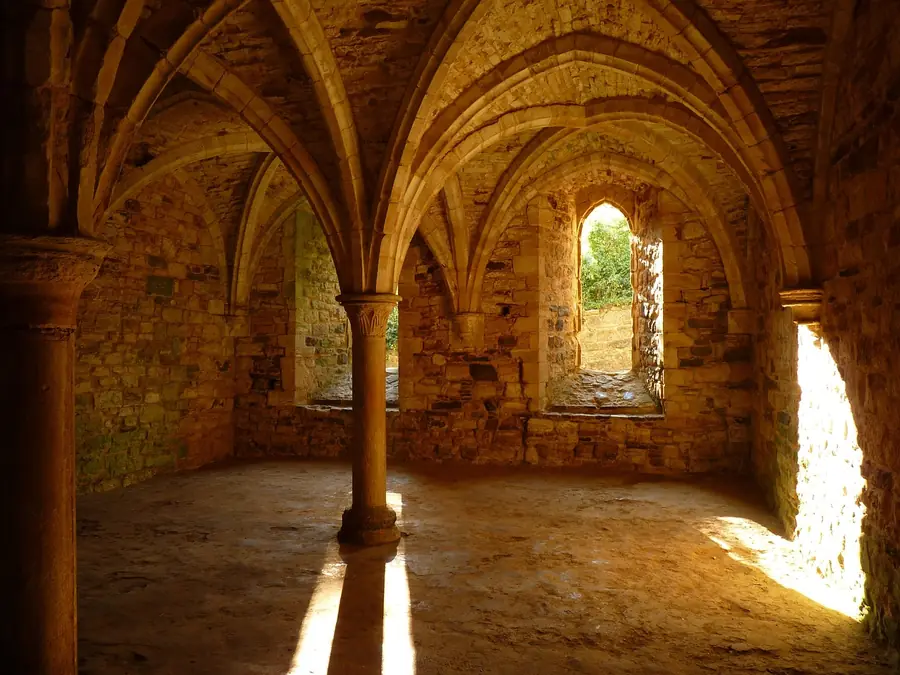
Battle Abbey stands at the top of the High Street in the town of Battle, twenty-two kilometres north-east of Eastbourne, and it is built on the place where the Battle of Hastings was fought on 14 October 1066.
It is a partially ruined Benedictine abbey, founded by William the Conqueror as penance for the killing, dedicated to St Martin of Tours, and — according to the tradition — sited so that its high altar stood on the spot where Harold fell. It is a Scheduled Monument and English Heritage runs it.
Harold Godwinson had marched his army from Stamford Bridge in Yorkshire, where he had beaten a Norwegian invasion three weeks earlier, to meet William’s Norman force landed at Pevensey — which is on the coast six kilometres from Eastbourne.
The English took the ridge; the Normans attacked uphill through most of a day. The shield wall held until it broke, in the accepted account, when part of the English line pursued a feigned Norman retreat down the slope. Harold was killed, the line collapsed, and England had a new ruling class, a new language of government and a new architecture within a generation.
It is arguably the most consequential day in English history, and the ground it happened on is still a field you can walk across.
The battlefield walk is the heart of it — a circuit around the ridge and down the slope the Normans attacked up, with the audio guide that visitors single out again and again as one of English Heritage’s best. It works by position: you stand where the shield wall stood, and it tells you what was in front of you.
Allow two to three hours for the full circuit.
The visitor centre and exhibition were rebuilt and are strong on context — who the armies were, what the sources actually say, and where the tradition is uncertain.
The abbey ruins include the great gatehouse of 1338 on the High Street, the monks’ dormitory range with its vaulted undercroft, and the outline of the church, with a memorial stone marking the traditional site of the high altar and Harold’s death.
The Norman-era terrace and the roof walk in the gatehouse give a view over the whole field.
The rest of the abbey precinct is occupied by a school and is not open.
Admission charged; free to English Heritage members. Book online in advance in summer.
Time: two to three hours.
Facilities: café, shop, toilets.
Access: the battlefield trail is a grass field with slopes and can be muddy; there is a shorter accessible route and a viewing terrace. The abbey ruins involve steps.
Getting there: Battle station is a five-minute walk from the gatehouse, on the line from Hastings to London — one of the easiest major heritage sites in England to reach by train. By road it is about thirty-five minutes from Eastbourne.
The town of Battle has pubs and cafés along the High Street facing the gatehouse.
Pevensey Castle, where William landed, is on the way back to Eastbourne and makes the pair.
Hastings Old Town is fifteen minutes south.
Yes — the battle took place on this ridge, six miles inland from Hastings, and the abbey was founded on the site afterwards.
Yes. It is included and is one of the best English Heritage produces — it works by position around the battlefield trail.
Two to three hours for the battlefield walk, exhibition and ruins.
Yes, Battle station is a five-minute walk, on the Hastings to London line.
Twenty-two kilometres, about thirty-five minutes by road.