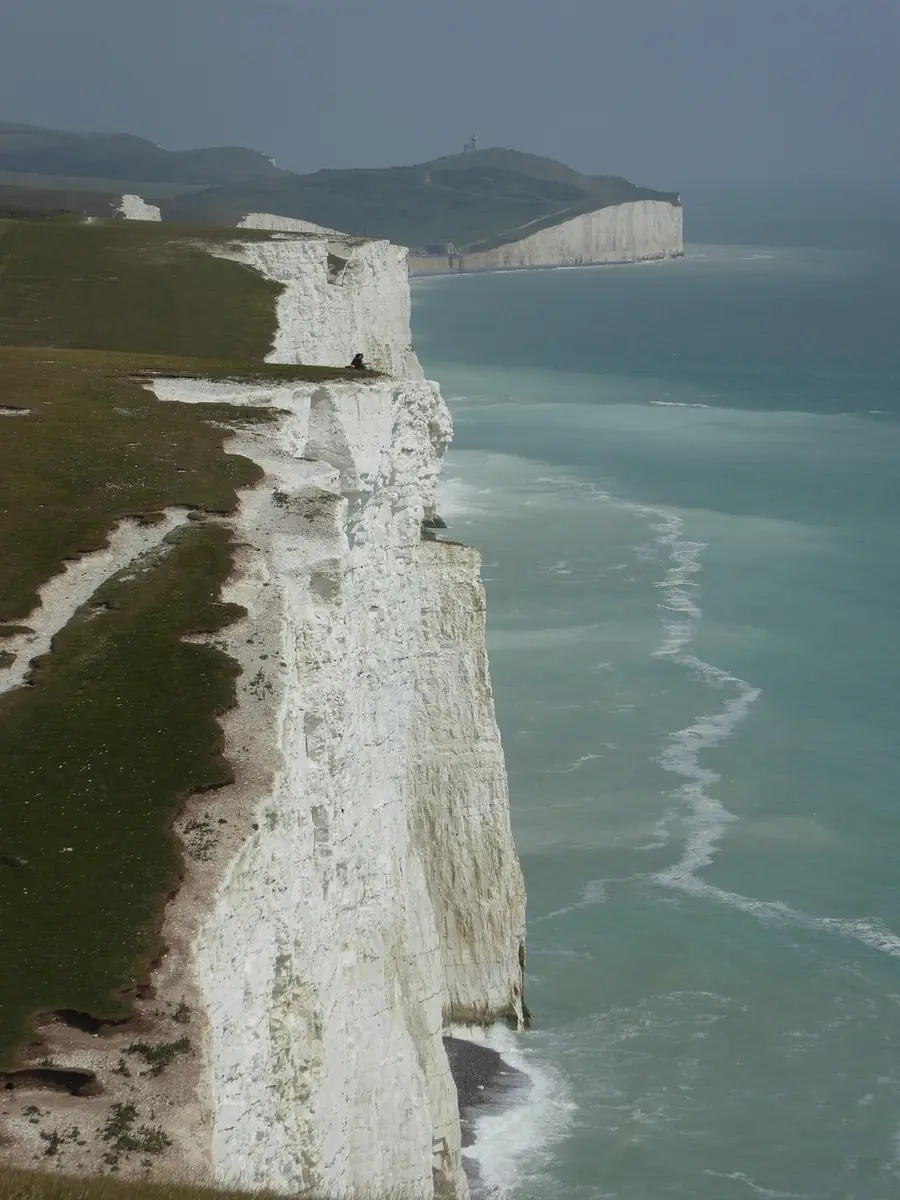
The Seven Sisters Country Park covers 280 hectares at the mouth of the Cuckmere valley, about eight kilometres west of Eastbourne, and it is run by the South Downs National Park Authority from the visitor centre at Exceat on the A259.
It is the western bookend of the Seven Sisters, and its particular quality is that — unlike almost everything else on this coast — the main walk is flat.
The river reaches the sea here through the only undeveloped river mouth on the Sussex coast: no harbour, no town, no sea wall.
What you see is a valley floor of chalk grassland with the meanders of the old river looping across it, and a straight artificial cut running beside them. The cut was made in 1846 to speed drainage and improve navigation; the meanders were left, and they now hold still water and are a wildlife site in their own right. The result — an oxbow landscape against white cliffs — is one of the most reproduced views in England.
At the seaward end is a shingle beach with the Seven Sisters rising to the east and the Coastguard Cottages perched on the cliff to the west.
From the visitor centre at Exceat to the beach is about 1.6 kilometres each way along a level, surfaced track beside the cut. It is the easiest walk to a great view anywhere on this coast, and it is manageable with pushchairs and, in dry conditions, with wheelchairs.
At the beach the shingle is steep and the swimming is unsupervised and subject to strong currents at the river mouth; most people come to look rather than swim.
For more, the South Downs Way climbs east over the Seven Sisters to Birling Gap — five kilometres of steep, relentless up-and-down, and a superb walk. West, the path climbs to the Coastguard Cottages and on towards Seaford Head, from which the classic photograph of the Sisters is taken.
Inland, the valley path runs up to Alfriston, a village of timber and flint with the National Trust’s Clergy House — the first building the Trust ever bought, in 1896, for £10.
The chalk grassland holds orchids and a strong butterfly list — chalkhill blue, adonis blue, marbled white. The meanders and the marsh hold waders, wildfowl and, in summer, dragonflies in numbers. Seals are seen offshore, and the shingle carries specialist plants including sea kale and yellow horned-poppy.
Free to enter; the car park at Exceat is charged and fills early at weekends and in summer.
Visitor centre, café and toilets at Exceat.
Buses run along the A259 between Eastbourne, Seaford and Brighton and stop at the park — which makes the one-way clifftop walk to Birling Gap or Eastbourne easy to arrange.
Exposure: the valley funnels wind off the Channel. It is colder than inland.
Note: the former Sheep Centre near East Dean, which some older guides list here, is no longer operating.
About 1.6 kilometres each way from the Exceat visitor centre, on a level surfaced track.
The main track to the beach is level and surfaced and works with pushchairs and, in dry conditions, wheelchairs. The clifftop paths are not.
Entry is free; parking at Exceat is charged.
From Seaford Head on the western side, looking back across the river mouth to the Sisters — a separate walk from the far side of the valley.
The beach is shingle and unsupervised, with strong currents at the river mouth. Most visitors come for the walk and the view.