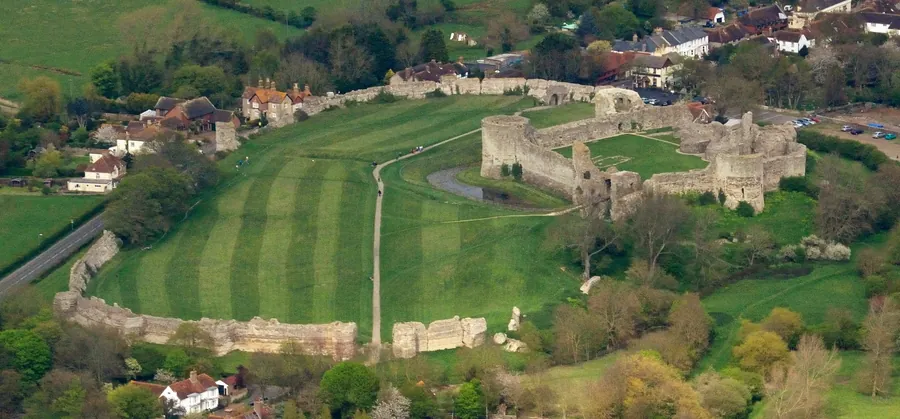
Pevensey Castle is seven kilometres east of Eastbourne, and it has the longest continuous military history of any site in Britain: it was fortified around AD 290 and it was still being fortified in 1940.
That is sixteen and a half centuries of the same walls being used for the same purpose, which is not a claim many places can make.
The outer walls are Roman. Anderitum was one of the Saxon Shore forts — the chain of late-Roman coastal strongholds along the south and east coasts — and it was unusual in shape: an irregular oval following the contour of what was then a peninsula in a tidal lagoon, rather than the standard playing-card rectangle.
Its purpose is debated. The long-standing view was that the Shore forts defended Britain and Gaul against Saxon raiders. A more recent argument is that they were built by a usurper — Carausius or Allectus, who ruled Britain in secession during the 280s and 290s — to keep the legitimate Roman state out.
Much of the Roman wall survives to near full height with its bastions, which is exceptional.
On 28 September 1066, William landed his invasion fleet at Pevensey and occupied the empty Roman fort as a base, throwing up an earth-and-timber castle in the eastern corner before moving on to Hastings.
The stone Norman castle in that corner — keep, curtain wall, towers and gatehouse, inside its own moat — came later, and stands within the Roman circuit. You therefore walk through a third-century Roman gate to reach an eleventh-to-thirteenth-century English castle, which is the site’s whole appeal in one sentence.
It was besieged repeatedly, held out several times, and slid into ruin as the sea retreated and the lagoon silted into the Pevensey Levels. The castle is now more than a kilometre inland.
In 1940 it was recommissioned: pillboxes and machine-gun posts were built into the Roman and medieval walls, deliberately camouflaged to look like masonry. They are still there, and finding them is one of the pleasures of a visit.
Expectations matter here. It is a ruin — walls, towers, an undercroft, a dungeon — not a furnished castle, and there is no roofed interior to speak of. Some visitors find the admission price steep for what is on the ground, and that is a fair criticism if you arrive expecting rooms.
What you are actually buying is the interpretation, the towers you can climb and the outer Roman circuit, which is free to walk — the grassy interior between the Roman walls and the Norman castle is open ground.
There are ghost tours and events through the year, which visitors rate highly.
Admission to the Norman castle is charged; free to English Heritage members. The Roman enclosure is open.
Time: an hour to ninety minutes.
Parking: a car park nearby, and a pub on the corner.
Access: grass and uneven ground; the towers involve narrow spiral stairs.
Getting there: Pevensey and Westham station is a short walk, on the Eastbourne–Hastings line. By road it is fifteen minutes from Eastbourne.
The Pevensey Levels, a large wetland reserve behind the village, with rare aquatic plants and invertebrates.
Battle Abbey, where the campaign that began here ended, is twenty minutes north-east.
Westham church next door is late Norman and was among the first churches the Normans built in England.
Yes — the fleet landed at Pevensey on 28 September 1066 and used the Roman fort as its first base.
The outer walls are Roman, from around AD 290. The castle inside them is Norman and later.
The Roman enclosure is open ground; admission is charged for the Norman castle.
It is a ruin — walls, towers, an undercroft and a dungeon. Visitors expecting furnished rooms are sometimes disappointed; those who come for the layered history are not.
Second World War pillboxes, built into the medieval and Roman masonry in 1940 and camouflaged to match it.