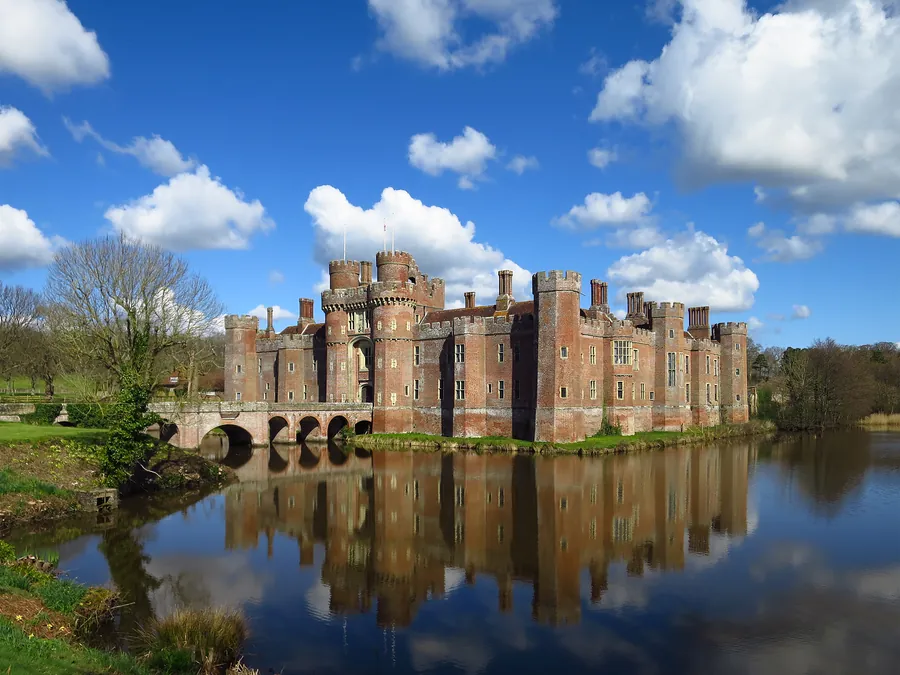
Herstmonceux Castle sits twelve kilometres north of Eastbourne, moated, symmetrical and improbably intact, and it is important for a reason that is easy to miss: it is one of the oldest significant brick buildings still standing in England.
Construction began in 1441 under Sir Roger Fiennes, Treasurer of the Household to Henry VI, and continued after his death in 1449 under his son, Lord Dacre. The bricks were made from local clay by builders brought over from Flanders, at a time when England had essentially forgotten how to build in brick — the technique had lapsed after the Romans and was reintroduced from the Low Countries in the fifteenth century.
Both, and deliberately.
Herstmonceux has a moat, a gatehouse, battlements and towers, but the walls are thin, the windows are large and low, and the whole arrangement would not have survived a serious assault. It was built in the era when English fortification was becoming display: a statement of rank in an expensive new material, with the vocabulary of defence used decoratively.
It was gutted in 1777 — stripped for its materials, leaving a shell — and stood ruined for a century and a half before being rebuilt from within the surviving walls in the 1910s and 1930s. The exterior is genuinely fifteenth-century; the interior is a twentieth-century reconstruction, which is worth knowing before you go in.
From 1957 to 1988 it housed the Royal Greenwich Observatory, moved out of London to escape light pollution. It is now the international study centre of Queen’s University in Canada.
The guided castle tour is the main event, and it is consistently the thing visitors rate most highly. Because the building is a working university facility, the interior is only accessible on a tour, and tours run on set days — check before travelling, because a proportion of disappointed visitors arrive on days when the castle itself is closed and only the grounds are open.
The tour runs around an hour and is, by common account, too long for young children.
The gardens are the other half: walled Elizabethan gardens, a rose garden, herbaceous borders, a rhododendron garden, woodland walks, ancient sweet chestnuts, a lake, sundials, and a rope maze.
Two to three hours covers the grounds comfortably.
Families arriving expecting a children’s attraction should recalibrate. The playground is small — essentially a climbing frame — and the grounds are gardens rather than activity space. Visitors who came for a family day out have said as much.
Come for the building, the tour and the planting, with children who will walk. The Observatory Science Centre next door is the family half of this site, and the two together make a proper day.
Admission charged for grounds; the castle tour is a separate ticket. Combined tickets with the Observatory are available and are the sensible buy.
Time: two to three hours for the grounds, plus an hour for the tour.
Facilities: café, shop, toilets.
Access: the grounds are largely grass and gravel with slopes; the castle tour involves stairs.
Getting there: near Herstmonceux village, about twenty-five minutes from Eastbourne by road. Public transport is limited.
It was begun in 1441, making it one of the oldest significant brick buildings in England.
Only on a guided tour, on set days — the castle is a working university study centre. Check the tour schedule before travelling.
No. The building was gutted in 1777 and the interior was reconstructed in the twentieth century within the original walls.
Not especially — the playground is small and the tour is long. The Observatory Science Centre next door is the family part of the site.
It moved here from London in 1957 to escape light pollution and stayed until 1988.